

Due to its flexible manufacturing process and adjustable performance, plywood has developed a rich classification system. It can be classified according to various dimensions such as raw material tree species, structural form, bonding performance, and intended use, to meet the differentiated needs of different fields.
According to the raw material tree species, it can be divided into hardwood plywood and softwood plywood. Hardwood veneers have a fine texture and high strength, and are often used in furniture and decoration; softwood veneers have a straight grain and are relatively inexpensive, and are mostly used in construction formwork and packaging, where both strength and economy are important. There are also mixed wood types, which achieve complementary performance through the combination of different tree species, balancing both appearance and mechanical properties.
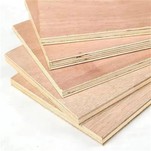
According to the structural form, it can be divided into ordinary plywood and special structure plywood. Ordinary plywood mostly has a regular number of layers in an orthogonal laminated structure, and the number of layers is usually odd to ensure symmetrical stability; special structures include sandwich panels and gradient structure panels. Sandwich panels add a thick core material in the middle layer to improve thermal insulation or sound insulation performance, while gradient structures adjust the veneer density or thickness in the thickness direction to achieve a combination of rigidity and flexibility in specific areas.
According to bonding performance and durability, it can be classified by water resistance level. According to national standards, it is divided into Class I (weather-resistant, boiling water-resistant), Class II (water-resistant), Class III (moisture-resistant), and Class IV (not moisture-resistant) based on bonding strength and water and heat resistance, corresponding to outdoor structures, humid environments, indoor dry conditions, and temporary use occasions, respectively. Environmental performance is also a classification criterion, and low-formaldehyde emission products are increasingly becoming the mainstream choice for indoor applications.
According to its use, it can also be divided into special categories such as construction, furniture, packaging, and vehicle and ship use. Each category has specific designs in terms of thickness, strength, and surface quality. For example, plywood for vehicles and ships emphasizes salt spray resistance and shock resistance, while packaging plywood focuses on impact resistance and moisture resistance.
The diversified classification system enables plywood to accurately meet the technical and economic requirements of different industries, ensuring functional realization while expanding the breadth and depth of material applications.
Classification and Characteristics Analysis of Plywood
Dec 12, 2025

Send Inquiry
Categories
Contact Us
- WeChat&whatsapp:
+8613365001069 (Jane Lin-Sales Director) - Email: jane@mjwoodindustry.com (Sales Director)
- Email: rita@mjwoodindustry.com (Sales)
- CBD Sales Office Add: Room 1005, Building C, No. 88 Shuixian Street, Longwen District, Zhangzhou City, Fujian Province
- Factory: 5 manufacturing bases located in Fujian province, China.