

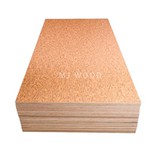
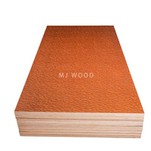
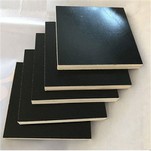
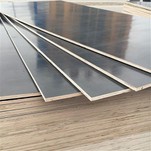
As an important category of engineered wood products, plywood, with its unique structural design and composite technology, possesses several significant characteristics that enable it to maintain widespread application and competitive advantages among various wood materials. Its performance advantages stem from the organic combination of the lamination principle and materials science, allowing it to meet complex and diverse needs in terms of strength, stability, processability, and adaptability.
Firstly, plywood exhibits excellent dimensional stability. The use of an odd number of veneers laminated in alternating fiber directions effectively counteracts the anisotropic shrinkage and expansion of wood caused by humidity changes, significantly reducing the risk of warping and cracking. This structural characteristic allows the panels to maintain flatness and regular shape even in environments with fluctuating temperature and humidity, making them suitable for construction formwork and furniture manufacturing requiring high precision.
Secondly, it possesses balanced mechanical properties and strong design flexibility. The orthogonal arrangement of layers provides the panels with good load-bearing capacity in both the plane and thickness directions, and its nail-holding strength and bending strength are superior to solid wood panels of the same thickness. By combining veneers of different wood species and adjusting the number of layers, it can be optimized for load-bearing, toughness, or lightweight applications, meeting the diverse needs of various scenarios, from heavy-duty structures to lightweight decorations.
Thirdly, plywood has superior processing performance. Its surface is flat and the texture is uniform, facilitating sawing, drilling, sanding, and surface decoration, allowing for flexible realization of various shapes and finishes. At the same time, its characteristics of being glueable, paintable, and film-coatable make it easy to integrate into industrialized production and personalized customization processes.
In terms of durability, depending on the adhesive and treatment process, different grades of products are available, offering water resistance, moisture resistance, and weather resistance, adapting to diverse indoor and outdoor environments. Environmental performance is also continuously improving, with low-formaldehyde emission plywood gradually becoming the mainstream for indoor applications, meeting the requirements of green building and healthy living.
Furthermore, plywood facilitates the efficient utilization of wood resources, integrating small-diameter timber and fast-growing timber, reducing the consumption of high-quality large-diameter timber, and offering significant ecological and economic benefits. It is these comprehensive characteristics that enable plywood to continue playing a crucial role in modern manufacturing and construction industries.
Main Characteristics And Industrial Significance Of Plywood
Nov 13, 2025


Send Inquiry
Latest News



Contact Us
- WeChat&whatsapp:
+8613365001069 (Jane Lin-Sales Director) - Email: jane@mjwoodindustry.com (Sales Director)
- Email: rita@mjwoodindustry.com (Sales)
- CBD Sales Office Add: Room 1005, Building C, No. 88 Shuixian Street, Longwen District, Zhangzhou City, Fujian Province
- Factory: 5 manufacturing bases located in Fujian province, China.