

Plywood machinery is the core equipment system that enables the continuous and mass production of plywood from raw materials to finished products. Its working principle is rooted in the deep integration of wood processing technology with mechanical transmission, thermal control, and automation technology.Each process unit, under strict process sequencing and parameter coordination, transforms dispersed wood units into structurally stable and performance-controllable laminated panels. Its operational logic embodies the organic unity of material properties, mechanical transmission, and process control.
In the raw material pretreatment stage, the working principle of the machinery focuses on physical separation and size standardization. The log debarking machine uses the friction of rotating brush rollers or high-pressure water jets to break the bond between the bark and the wood, achieving efficient debarking and providing a clean surface for subsequent veneer cutting. The cutoff saw, based on set length parameters, uses the reciprocating or rotating cutting motion of the saw blade to cut the logs into uniform lengths, ensuring consistency in the feeding process for the rotary cutting operation. The drying kiln uses hot air circulation or indirect steam heating to gradually evaporate the moisture from the wood. Its working principle relies on the uniform control of the temperature and airflow fields, stabilizing the moisture content within the process window to prevent deformation and gluing defects during processing.
The core of the veneer preparation stage is the precise control of the cutting motion. The working principle of the rotary cutting machine is as follows: the log is clamped and rotated around its axis, and the high-speed rotating cutting tool feeds along the tangent direction of the wood. Through the relative motion between the tool and the wood, the wood is continuously cut into thin veneers of uniform thickness. The cutting thickness is determined by the ratio of the feed speed of the tool relative to the log and the rotation speed of the log. Parameters need to be dynamically adjusted according to the material hardness and grain direction to ensure a smooth veneer surface and intact fibers. The slicing machine, on the other hand, obtains veneers with beautiful decorative surfaces by fixing the wood and using a reciprocating cutting motion of the tool. Its working principle emphasizes the sharpness of the tool edge and the stability of the feeding process to reduce fiber tearing and surface defects.
The working principles of the gluing and assembly processes focus on the uniform application of adhesive and the precise construction of the interlayer structure. The glue spreader applies a precise amount of adhesive evenly to the veneer surface using a metering pump or roller transfer mechanism. The key is controlling the thickness and uniformity of the glue layer, preventing insufficient glue leading to poor bonding or excessive glue causing waste. The layup table uses positioning pins, baffles, and clamping devices to stack multiple layers of veneer according to the principle of perpendicular fiber orientation, forming a symmetrical mechanical structure. This process requires strict control of veneer alignment accuracy to ensure no misalignment between layers, laying the foundation for subsequent bonding strength.
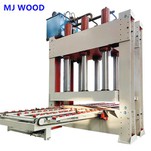
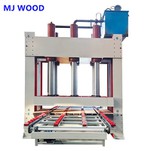
The hot pressing process is the core stage of plywood formation, its working principle based on the synergistic effect of heat and pressure to cure the adhesive layer. The hot press transfers heat to the veneer stack through heating plates, activating the adhesive molecules and causing cross-linking reactions; simultaneously, a uniform pressure is applied through a hydraulic or mechanical pressing system, forcing the adhesive layer into close contact with the wood surface, expelling air bubbles and filling microscopic voids. The matching of temperature, pressure, and time directly affects the bonding strength and flatness of the panel: too high a temperature can lead to charring of the adhesive layer, while too low a temperature results in incomplete curing; too much pressure may cause excessive compression of the wood or extrusion of the adhesive, while too little pressure results in weak interlayer bonding. Modern hot presses often use segmented pressing and programmed temperature control technology to adapt to the needs of different thicknesses and adhesive types, ensuring the uniformity of the curing process.
The post-processing and inspection processes revolve around dimensional finishing and quality assessment. The edge trimming saw removes irregular parts of the veneer stack edges through the linear motion of reciprocating or rotating saw blades, ensuring accurate and square dimensions of the finished product; the sanding machine uses the high-speed rotation of sanding belts or rollers and the feeding motion of the panel to remove surface processing marks and improve flatness through grinding. Its working principle requires controlling the sanding pressure and feeding speed to avoid excessive grinding leading to thickness deviations. Quality inspection equipment uses optical, mechanical, or chemical sensing technologies to quantitatively determine the thickness, bonding strength, formaldehyde release, and appearance defects of the panel. Its working principle is to convert physical or chemical signals into analyzable data, providing a basis for quality grading and process improvement. In summary, the working principle of plywood machinery is a systems engineering approach guided by process requirements, utilizing mechanical transmission to transform material forms, thermal control to drive adhesive layer curing, and automation technology to ensure process coordination. The precise coordination of the working principles of each stage ensures the high precision, high performance, and high stability of plywood products, forming the technological foundation for large-scale production in the modern plywood industry.
Analysis of the Working Principles of Plywood Machinery
Dec 23, 2025

Send Inquiry
Categories
Contact Us
- WeChat&whatsapp:
+8613365001069 (Jane Lin-Sales Director) - Email: jane@mjwoodindustry.com (Sales Director)
- Email: rita@mjwoodindustry.com (Sales)
- CBD Sales Office Add: Room 1005, Building C, No. 88 Shuixian Street, Longwen District, Zhangzhou City, Fujian Province
- Factory: 5 manufacturing bases located in Fujian province, China.