

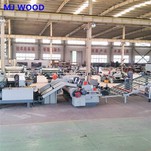
In the field of plywood manufacturing, machinery and equipment, as the core carriers of the production chain, directly impact product accuracy, energy consumption levels, and production stability.Faced with continuously increasing market demands for board quality and rigid constraints on production costs, building scientific and systematic mechanical solutions has become a key path for enterprises to maintain competitiveness.
Plywood machinery solutions should revolve around four dimensions: stable operation, precise control, energy efficiency optimization, and intelligent upgrading. Stable operation is fundamental and should be strengthened through full lifecycle management of equipment reliability: from work condition matching analysis during the selection phase, to the establishment of a preventive maintenance system after commissioning, and then to the redundant configuration and rapid replacement mechanisms of key components, forming a comprehensive guarantee covering procurement, use, and maintenance, minimizing the probability of unplanned downtime.
Precise control focuses on process adaptability and parameter consistency. For core processes such as hot pressing, gluing, and sanding, it is necessary to optimize the mechanical motion trajectory and pressure distribution logic in combination with board thickness tolerance, adhesive characteristics, and environmental temperature and humidity variables. For example, a closed-loop feedback system can be used to real-time correct the uniformity of the hot press plate temperature field, or servo drive technology can be used to improve the coordination accuracy of the gluing roller speed and pressure, ensuring that the glue layer thickness deviation is controlled within the process-allowed range, reducing the defect rate from the source.
Energy efficiency optimization emphasizes the efficient utilization of resources. This can be achieved through lightweight modification of the transmission system to reduce ineffective load, introducing variable frequency speed control technology to match load changes, and reducing idle energy consumption; conducting flow resistance analysis and leakage monitoring of hydraulic and pneumatic circuits to improve energy conversion efficiency. At the same time, combining waste heat recovery devices to reuse waste heat from the hot pressing process further reduces overall energy consumption costs.
Intelligent upgrading is a breakthrough direction for the future. Leveraging Internet of Things technology to achieve online monitoring of equipment status, modeling multi-dimensional data such as vibration, temperature, and current to predict potential risks such as bearing wear and motor overload; introducing digital twin systems to simulate equipment response under different production schemes, assisting in rapid optimization of process parameters. Intelligent upgrading not only improves the timeliness of operation and maintenance decisions but also promotes the transformation of equipment management from "experience-driven" to "data-driven." Overall, the essence of plywood machinery solutions lies in integrating technology, management, and innovation through a systemic approach, addressing pain points in traditional production through multi-dimensional collaboration, and building a manufacturing support system for enterprises that is stable, economical, and forward-looking.
Comprehensive Solutions for High-Efficiency Operation of Plywood Machinery
Dec 24, 2025


Send Inquiry
Categories
Contact Us
- WeChat&whatsapp:
+8613365001069 (Jane Lin-Sales Director) - Email: jane@mjwoodindustry.com (Sales Director)
- Email: rita@mjwoodindustry.com (Sales)
- CBD Sales Office Add: Room 1005, Building C, No. 88 Shuixian Street, Longwen District, Zhangzhou City, Fujian Province
- Factory: 5 manufacturing bases located in Fujian province, China.