

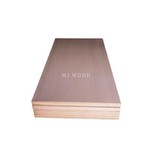
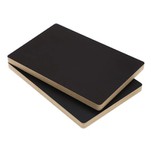
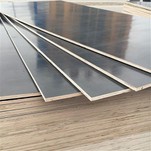
Hardwood plywood is widely used in furniture making, interior and exterior decoration, and structural cladding due to its high strength, beautiful grain, and excellent dimensional stability. To achieve ideal installation results and ensure long-term reliability, a systematic installation process and strict technical requirements must be followed, with meticulous control at every stage, from initial preparation to final fixing.
Preparation before installation is crucial. The specifications, grade, quantity, and grain direction of the plywood should be checked against the design drawings to ensure they match the functional and aesthetic requirements of the application. For hardwood plywood used for load-bearing or exterior walls, its water resistance, moisture resistance, and bonding strength indicators should be checked, and defects such as blistering, delamination, and edge damage should be eliminated. The substrate surface at the construction site should be flat, clean, and dry, free from oil stains, dust, and loose particles. Leveling or moisture-proofing treatment should be applied if necessary to prevent deformation or delamination due to uneven substrate or moisture intrusion.
Layout and marking are fundamental steps in the installation process. Reference lines should be marked on the substrate according to the layout plan, clearly defining the arrangement direction, joint positions, and starting points of the plywood panels. Staggered jointing should be used as much as possible to distribute stress and reduce the risk of warping. For large-area installations or wall cladding, a trial layout can be performed beforehand to check the overall flatness and visual effect, and then the panels can be numbered and installed sequentially.
The fixing method should be chosen appropriately based on the panel thickness, substrate material, and load requirements. For mechanical fastening, screws or nails of suitable length and penetration depth should be used, with a spacing generally controlled between twenty and thirty centimeters. Countersinking should be used to avoid surface protrusions that could damage the aesthetics. Self-tapping screws should be driven in at an angle to the panel surface to enhance gripping force. When using adhesive fixing, an environmentally friendly adhesive with good compatibility with both the plywood and the substrate should be applied evenly. The joints must be tightly closed without gaps, and temporary clamps or weights should be used to apply pressure until the adhesive is fully cured. For applications requiring a seamless effect, joint strips or patches of the same material can be used at the joints to improve overall integrity and waterproofing. Attention to detail is crucial during installation. Door and window openings or irregularly shaped areas require precise cutting to ensure neat edges and tight joints with surrounding components; when stacking multiple layers, anti-slip mats or locating pins should be added between layers to prevent displacement. The construction environment's temperature and humidity should be kept stable, avoiding work under conditions of drastic changes to reduce expansion and contraction stress. After completion, residual adhesive and debris on the panel surface should be cleaned promptly, and the firmness of fasteners and surface flatness should be checked, with any defects immediately rectified.
Post-installation maintenance is also essential. During the initial installation period, hardwood plywood should be protected from severe impacts and heavy pressure, and the environment should be well-ventilated to allow the adhesive to fully cure. During long-term use, the edge sealing and surface coating should be regularly inspected, and any signs of moisture damage, cracking, or delamination should be addressed promptly to extend its service life.
In summary, the installation of hardwood plywood is a technical process encompassing measurement, fastening, and protection. Only with thorough preparation, precise positioning, secure fastening, and meticulous attention to detail can its structural safety and flat appearance be ensured, and its superior performance maintained throughout its lifespan.
Installation Methods And Technical Requirements For Hardwood Plywood
Nov 28, 2025


Send Inquiry
Latest News



Contact Us
- WeChat&whatsapp:
+8613365001069 (Jane Lin-Sales Director) - Email: jane@mjwoodindustry.com (Sales Director)
- Email: rita@mjwoodindustry.com (Sales)
- CBD Sales Office Add: Room 1005, Building C, No. 88 Shuixian Street, Longwen District, Zhangzhou City, Fujian Province
- Factory: 5 manufacturing bases located in Fujian province, China.