

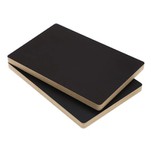
As an important member of the engineered wood family, plywood, with its structural stability and functional versatility, has become one of the core materials in construction, furniture, packaging, and other fields. Essentially, it is made by laminating multiple layers of veneer in a cross-grained pattern using adhesives.This process fundamentally solves the defects of natural wood, such as deformation and cracking, giving the material more balanced physical properties.
From a process perspective, the advantages of plywood stem from the scientific logic of "interlayer cross-lamination." The symmetrical arrangement of an odd number of veneer layers creates a mechanically balanced system, allowing the panels to maintain dimensional stability during changes in humidity; the combination of veneers from different tree species can be used to optimize strength, corrosion resistance, or flame retardancy. For example, poplar substrates improve toughness, while birch veneers enhance hardness, meeting diverse application needs. In addition, plywood retains the natural texture of wood, and its surface can be directly coated or laminated, adapting to aesthetic requirements ranging from simple home furnishings to high-end custom designs.
In terms of application, plywood is a versatile material across various industries. In construction, its high load-bearing capacity and nail-holding strength support engineering structures such as formwork and partitions; in furniture manufacturing, its lightweight and high-strength characteristics are ideal for the modular production of panel furniture; and the packaging industry relies on its impact resistance to ensure the safe transportation of precision instruments. In recent years, with the popularization of green building materials, environmentally friendly plywood with low formaldehyde emissions has gradually become the market mainstream, driving the industry towards a low-carbon transformation.
As a typical example of efficient resource utilization, plywood significantly improves wood utilization by using small-diameter timber and fast-growing trees in its composite processing, alleviating the pressure on natural forest harvesting. In the future, with improved process precision and functional innovations (such as waterproofing and fire-retardant modifications), plywood will continue to expand its value boundaries in sustainable construction and high-end manufacturing, becoming a key link connecting traditional woodworking with modern industry.
Plywood: The Core Composite Material Of Modern Woodworking
Nov 11, 2025
No Information



Send Inquiry
Latest News



Contact Us
- WeChat&whatsapp:
+8613365001069 (Jane Lin-Sales Director) - Email: jane@mjwoodindustry.com (Sales Director)
- Email: rita@mjwoodindustry.com (Sales)
- CBD Sales Office Add: Room 1005, Building C, No. 88 Shuixian Street, Longwen District, Zhangzhou City, Fujian Province
- Factory: 5 manufacturing bases located in Fujian province, China.