

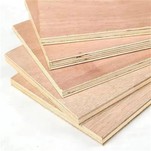
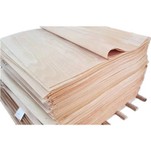
Veneer core plywood is a composite panel made by using a single, full-width wood veneer as the core layer, sandwiched between face and back veneers, and then glued, assembled, and hot-pressed.Compared to traditional particleboard or fiberboard core plywood, its core characteristic lies in the integrity and continuity of the core layer structure. This construction gives the material unique mechanical properties and processing advantages, leading to its widespread application in furniture manufacturing, architectural decoration, and packaging and transportation.
Structurally, the core layer of veneer core plywood consists of a single sheet of wood veneer, with the wood grain running parallel to the face veneer or arranged at a certain angle, thus forming a stable mechanical transmission path. This continuous structure effectively reduces stress concentration caused by gaps and uneven density in the core layer, resulting in higher strength and stiffness when the panel is subjected to lateral loads or bending moments. At the same time, the continuous distribution of fibers in the full-width veneer helps to suppress local deformation and warping, improving dimensional stability, which is particularly advantageous in large-span or heavy-load applications.
In terms of performance, veneer core plywood combines lightness and high strength. Because the core layer is made of a single material with a uniform structure, the overall density distribution of the panel is reasonable, reducing its weight while maintaining good load-bearing capacity. Its surface flatness is superior to most composite core panels, making it easy to apply veneers, coatings, or use directly as a decorative surface. Furthermore, the airtightness of the single core veneer is better, reducing the penetration of glue and moisture along the core layer cracks, thus improving moisture resistance and weather resistance, maintaining shape and functional stability even in environments with significant humidity changes.
Processing adaptability is another highlight of veneer core plywood. The continuous wood fiber structure makes mechanical processing such as cutting, drilling, and milling smoother, with less tool wear and higher surface finish, facilitating complex shapes and high-precision assembly. In furniture manufacturing, this material is often used to make load-bearing frames, tabletops, and door panels, simplifying process steps and improving product quality; in architectural decoration, it is suitable for wainscoting, ceilings, and lightweight partitions, combining strength and aesthetics.
Environmental protection and sustainability are also important considerations. High-quality veneer core plywood often utilizes low-formaldehyde or formaldehyde-free adhesives and employs scientific layup techniques to minimize wood waste and improve yield. Using sustainably managed tree species as core veneer material further reduces environmental impact and meets the requirements of green building and eco-friendly homes.
Overall, veneer core plywood, with its continuous structure, balanced performance, excellent workability, and environmental advantages, is an ideal material for applications requiring high strength, stability, and processing precision. As manufacturing processes improve and application fields expand, its overall value will continue to be realized, providing reliable and efficient panel solutions for the modern wood products industry.
Technical Characteristics and Application Value of Veneer Core Plywood
Dec 30, 2025

Send Inquiry
Categories
Contact Us
- WeChat&whatsapp:
+8613365001069 (Jane Lin-Sales Director) - Email: jane@mjwoodindustry.com (Sales Director)
- Email: rita@mjwoodindustry.com (Sales)
- CBD Sales Office Add: Room 1005, Building C, No. 88 Shuixian Street, Longwen District, Zhangzhou City, Fujian Province
- Factory: 5 manufacturing bases located in Fujian province, China.