

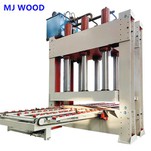
The design philosophy of plywood machinery is based on meeting production process requirements while integrating forward-thinking concepts of structural optimization, process coordination, energy efficiency improvement, and intelligent manufacturing. This forms a systematic guiding principle that ensures product quality, improves production efficiency, and considers sustainable development. Its core lies in using process requirements as the driving force and mechanical performance as the foundation, achieving the unification of equipment function and industrial value through multidisciplinary integration.
The design philosophy first emphasizes process compatibility. Plywood production involves multiple processes, including log debarking, cutting, veneer peeling, drying, gluing, layup, hot pressing, trimming, and sanding. Each process has significant differences in the required mechanical action accuracy, motion trajectory, load characteristics, and environmental adaptability. The design must deeply analyze the process mechanisms and key control points of different stages. For example, the feed speed and tool geometric parameters of the veneer peeling machine must match the wood hardness and grain direction, and the temperature field and pressure distribution of the hot press must ensure uniform glue curing and flat board formation. Only by translating process logic into mechanical structure and control schemes can the equipment accurately reproduce the process intent during operation.
Secondly, structural optimization and reliability are prioritized. Plywood machinery often operates under continuous heavy load conditions. The design must select materials and configurations reasonably to reduce inertial load and vibration sources while meeting stiffness and strength requirements. For example, the precision of the cooperation between the pressure roller and the guide rail, the clearance control of the transmission system, and the fatigue life analysis of key components should all aim for long-term stable operation and low failure rate. The introduction of modular design concepts can improve component versatility and maintenance convenience, shorten changeover and repair time, and enhance the life cycle value of the equipment.
Process coordination and automation integration are important directions in contemporary design. Modern plywood production lines tend towards seamless process衔接 and information exchange. Mechanical design must reserve standardized interfaces and communication protocols to enable data exchange and linkage control between individual machines and the central control system. Through the organic integration of sensing, execution, and feedback units, adaptive parameter adjustment, anomaly warning, and online quality monitoring can be achieved, resulting in an efficient and flexible production rhythm.
Energy efficiency and environmental protection concepts also profoundly influence the design thinking. The design should prioritize efficient drive and transmission solutions to reduce no-load energy consumption; waste heat recovery and intelligent temperature control strategies should be introduced in energy-intensive processes such as hot pressing and drying to reduce energy consumption per unit of product. Simultaneously, structural optimization should be implemented in noise control, dust collection, and harmful substance emission reduction to ensure equipment operation meets green manufacturing requirements.
Human-centered design and safety are also indispensable principles. The operating interface should be simple and intuitive, with key parameter settings and status displays clearly visible; safety protection devices must cover hazardous areas of mechanical movement and have interlocking and emergency stop functions to ensure personnel safety and equipment integrity.
Overall, the design philosophy of plywood machinery is based on precise process implementation, supported by reliable structure and process coordination, integrating intelligence, energy efficiency, and human-centered considerations. The goal is to create production equipment that is high-performance, highly adaptable, and sustainable, providing a solid technical foundation for the high-quality development of the plywood industry.
Design Concepts And Technological Orientation Of Plywood Machinery
Nov 19, 2025
Send Inquiry
Latest News



Contact Us
- WeChat&whatsapp:
+8613365001069 (Jane Lin-Sales Director) - Email: jane@mjwoodindustry.com (Sales Director)
- Email: rita@mjwoodindustry.com (Sales)
- CBD Sales Office Add: Room 1005, Building C, No. 88 Shuixian Street, Longwen District, Zhangzhou City, Fujian Province
- Factory: 5 manufacturing bases located in Fujian province, China.