

In the modern timber industry, plywood, along with solid wood panels, particleboard, and fiberboard, are all commonly used wood-based panels. However, due to differences in their structural principles and performance characteristics, there are significant differences in their application positioning and suitable scenarios. Clarifying these differences helps in making more precise material choices in production and use.
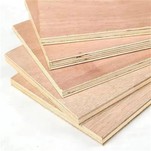
Compared to solid wood panels, the biggest difference in plywood lies in its structural composition and dimensional stability. Solid wood panels are sawn from a single piece of natural wood, retaining the natural grain and characteristics of the wood, but are prone to warping and cracking due to anisotropy under humidity changes. Plywood, on the other hand, is formed by laminating multiple layers of veneers with the fiber direction perpendicular to each other, creating a symmetrical mechanical system that effectively counteracts deformation stress, thus maintaining higher flatness and shape stability in fluctuating temperature and humidity environments. This structural advantage makes plywood superior to solid wood panels in applications suchs as large-span formwork and cladding panels in high-humidity environments.
Compared to artificial panels such as particleboard and fiberboard, plywood has advantages in mechanical strength and interlayer bonding. Particleboard is formed by gluing and hot-pressing wood chips, and its internal structure is granular, resulting in weaker lateral load-bearing capacity and nail-holding power; fiberboard uses wood fibers as raw materials, with uniform density but greater brittleness. Due to the orthogonal fiber direction between layers, plywood's overall bending, shear, and nail-holding performance is significantly better than the other two, and its surface flatness is more conducive to high-precision processing and finishing. Therefore, it is more widely used in load-bearing furniture, structural components, and applications requiring high aesthetic standards.
In terms of durability, plywood can achieve different levels of water resistance, moisture resistance, and weather resistance depending on the type of adhesive used, adapting to various indoor and outdoor environments; particleboard and fiberboard usually have poor water resistance and are prone to swelling and deformation when wet, and are mostly used in dry indoor environments. In addition, plywood can flexibly combine veneers of different tree species to achieve a balance between performance and cost, while solid wood panels are limited by the diameter and grain consistency of the raw materials, resulting in a narrower selection range and greater cost fluctuations.
There are also differences in environmental protection and resource utilization. Plywood efficiently utilizes small-diameter and fast-growing timber, improving the overall utilization rate of wood; solid wood panels, on the other hand, rely heavily on large-diameter, high-quality timber, leading to the depletion of valuable resources. While particleboard and fiberboard can also utilize wood scraps, they are inferior to plywood in terms of strength and reusability.
In summary, plywood, with its stable structure, balanced strength, good workability, and strong environmental adaptability, distinguishes itself from other wood-based panels and demonstrates unique value in engineering projects where both performance and economic efficiency are crucial.
Distinguishing Plywood From Other Wood-Based Panels
Nov 16, 2025

Send Inquiry
Latest News



Contact Us
- WeChat&whatsapp:
+8613365001069 (Jane Lin-Sales Director) - Email: jane@mjwoodindustry.com (Sales Director)
- Email: rita@mjwoodindustry.com (Sales)
- CBD Sales Office Add: Room 1005, Building C, No. 88 Shuixian Street, Longwen District, Zhangzhou City, Fujian Province
- Factory: 5 manufacturing bases located in Fujian province, China.